The Trust Gap Inside Flight Software
Traditional spacecraft security commonly protects the ground link, cryptographic keys, and execution environment. ARGUS focuses on the internal message path: the publish/subscribe fabric applications use after they are already onboard.
An open message bus assumes cooperative applications. ARGUS rejects that assumption for protected traffic. It treats publish, subscribe, command ownership, command completion, bridge transfer, and security reporting as explicit authorization decisions.
“The software bus is not merely middleware. It is a trust boundary.”
If identity and authorization are enforced inside the bus path, unauthorized applications should be denied through normal bus APIs while legitimate traffic retains bounded, deterministic behavior.
Bus-Enforced Zero Trust
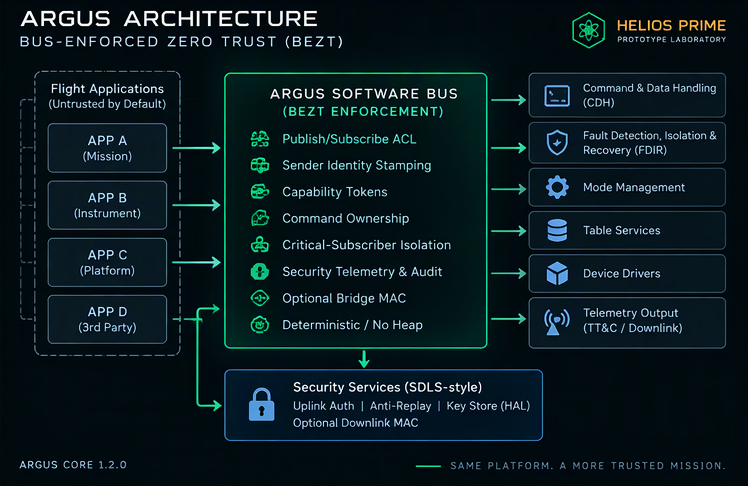
ARGUS places enforcement directly in the software-bus path so an application cannot bypass policy simply by omitting a security wrapper.
The bus stamps sender identity and generation from execution context rather than trusting caller-supplied identity.
Sensitive message classes are subject to mission policy and default-deny enforcement when BEZT is enabled.
Per-application or per-pipe capabilities bind privileged operations to authorized owners.
Mission command identifiers are explicitly claimed; completion requires the owning capability.
Noncritical queue failure is localized while loss to a critical consumer is separately recorded and reported.
Selected cross-boundary messages can use a truncated HMAC and anti-replay counter.
Denials, counters, audit records, and rate-limited FDIR reporting make enforcement observable.
Control and Experimental Method
The same message fabric, tested with enforcement off and on.
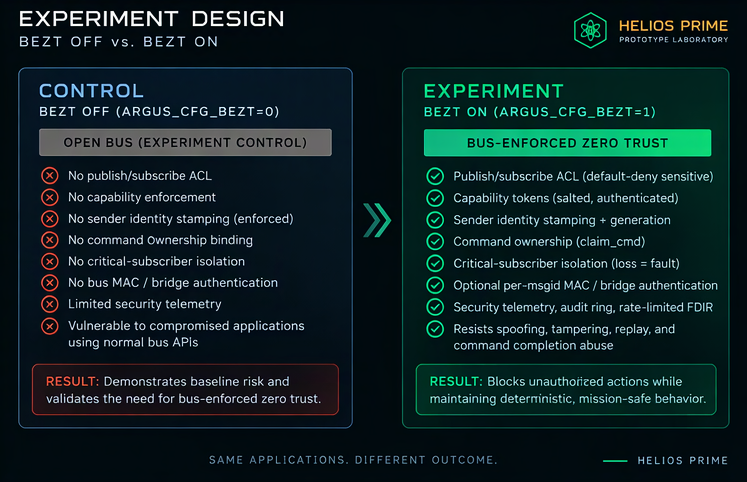
ARGUS_CFG_BEZT=0. The ACL, capability, and bridge-MAC gates compile out, producing the plain-bus comparison condition.
ARGUS_CFG_BEZT=1. Identity stamping, policy gates, owner binding, auditing, and optional bridge authentication are enforced in the bus path.
The experiment observes acceptance or denial, delivery behavior, audit and security counters, replay handling, critical-consumer effects, and whether repeated security violations can improperly drive fault escalation.
Adversarial Test Set
Threat behavior exercised through defined interfaces.
Spoofed Publisher
Attempt to publish protected command, mode, or fault traffic without authorization.
Unauthorized Subscriber
Attempt to observe sensitive message identifiers outside granted policy.
Command Hijack
Attempt to claim an already owned command path or forge command completion.
Replay
Resubmit authenticated traffic, including replay behavior across restart using persisted sequence state.
Tampering
Modify authenticated frames and exercise single-bit corruption against message authentication.
Malformed Input
Submit wrong key identifiers and truncated or oversized frames.
Stuck Subscriber
Fill a noncritical consumer while observing delivery to other and critical subscribers.
Security Event Pressure
Generate repeated denials to test rate-limited reporting and resistance to defensive mode escalation.
Findings and Verification Evidence
Host evidence supports the mechanism, with explicit limits on the claim.
Authorization Enforcement
Requirements and tests cover bus-stamped identity, sensitive-message ACLs, command ownership, and capability-authenticated completion.
Authenticated TT&C
The reference uplink uses SPI, a persistent 64-bit sequence number, and HMAC-SHA-256 with fail-closed handling for authentication, replay, and SPI failures.
Attack and Negative Testing
Documented cases include forged MAC, replay, replay across reboot, wrong key ID, malformed frames, bit-flip fuzzing, command-completion abuse, command-ID hijacking, and stuck-subscriber behavior.
Deterministic Constraints
The reference design uses fixed-depth queues, bounded loops, static storage, and no heap in the flight-oriented paths.
Traceability
Internal ARG requirements map security and quality behaviors to source locations, unit tests, harness cases, and host verification evidence.
Claim Boundary
The evidence demonstrates a host-verified reference implementation. It does not constitute flight qualification, formal certification, full SDLS interoperability, or an RMF authorization.
Lessons Learned
What the ARGUS experiment changes about flight-software trust.
A control that depends on every application calling it correctly is vulnerable to omission and compromise. Enforcement belongs in the common message path.
Sender identity is stronger when stamped by the bus from execution context instead of being asserted in message content.
Command registration and completion need explicit owner binding and authenticated completion, not first-subscriber convention.
A noncritical consumer should not silently deny service to other subscribers or prevent delivery to critical functions.
Security reporting needs bounded behavior and rate limits so repeated violations cannot become an uncontrolled FDIR trigger.
Authenticated TT&C protects the communications path. BEZT addresses identity and authority among onboard applications. Both layers are required for different reasons.
Embedded enforcement must preserve static resource limits, deterministic paths, bounded auditing, and explicit failure behavior.
Shared-address-space risk, mission key provisioning, bounded audit loss, cipher limitations, and host-only verification must remain visible.
A compromised core, shared-memory corruption, DMA, physical probing, side channels, weak mission key provisioning, and ground-segment compromise remain outside or beyond the protection demonstrated by this experiment. Encryption is not implemented in the reference TT&C tree; confidentiality remains a mission-provided cipher integration.
Experiment Status
ARGUS is an active Helios Prime experiment and host-verified reference baseline. The next useful phase is execution on representative flight hardware and integration with a flight-software framework and mission-specific policy, key management, and assurance artifacts.
Host-Verified Reference Baseline
Flight Software · Zero Trust · Fault Containment
ARGUS Core 1.2.0 · BEZT ON/OFF
Representative target execution and cFS integration