The Gap in Orbital Intent Analysis
Modern spacecraft operate with ambiguous profiles, multi-domain coordination, and strategically timed maneuvers. Traditional SDA systems track motion, but they do not interpret motivation or intent. They cannot explain why a satellite behaves the way it does.
ORION fills that gap. It is the first fusion engine built specifically to transform orbital behavior into structured, explainable intent intelligence. ORION does not classify objects, it reasons about them.
“ORION is the Nexus - the analytical core where orbital behavior becomes intent.”
Intent is not a single signal. It is a pattern formed by maneuvers, proximity behavior, sensor timing, historical analogs, and anomaly drift. ORION fuses these signals into a unified reasoning model.
The Nexus: Where Signals Converge
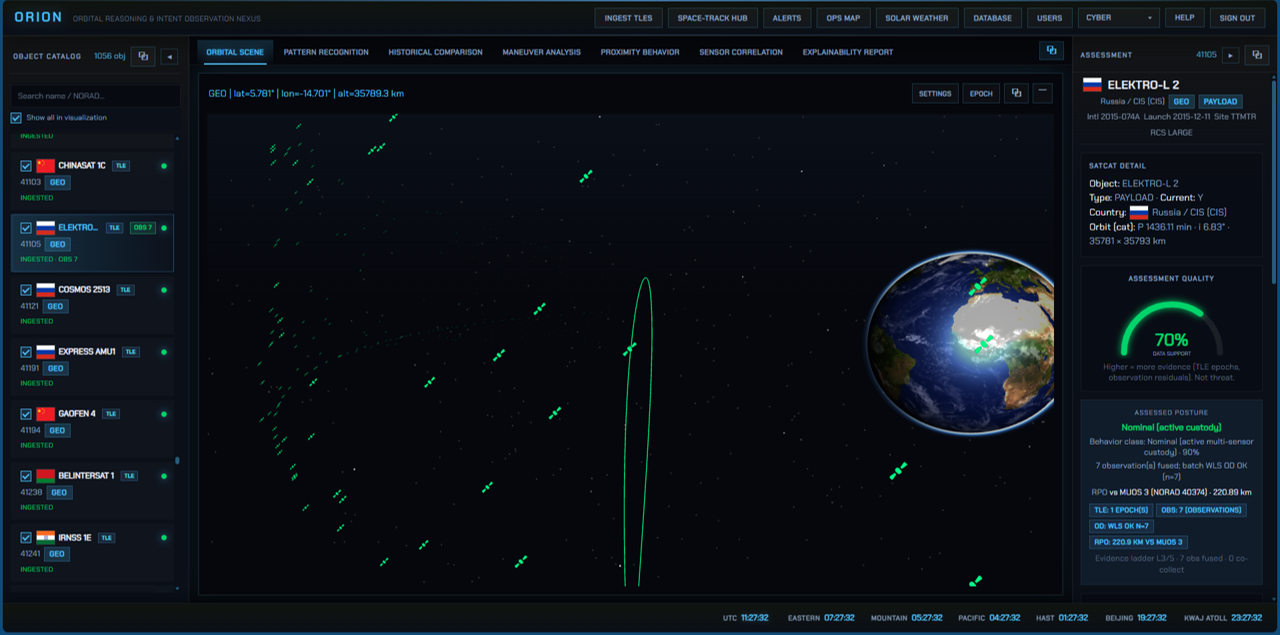
ORION is built as a Nexus - a central fusion point where multiple orbital signals converge and are transformed into structured intent intelligence.
Extracts orbital primitives, drift signatures, RPO vectors, and maneuver cadence.
Compares behavior against known inspection, servicing, and SIGINT campaigns.
Evaluates Δv magnitude, timing, efficiency, and orbital outcome.
Analyzes approach geometry, closure rate, and co-location persistence.
Correlates payload activation windows with maneuvers and proximity events.
Synthesizes all evidence into a unified intent likelihood vector.
Generates evidence chains, contradictions, and alternative hypotheses.
Reasoning Model
Structured intent inference from orbital behavior.
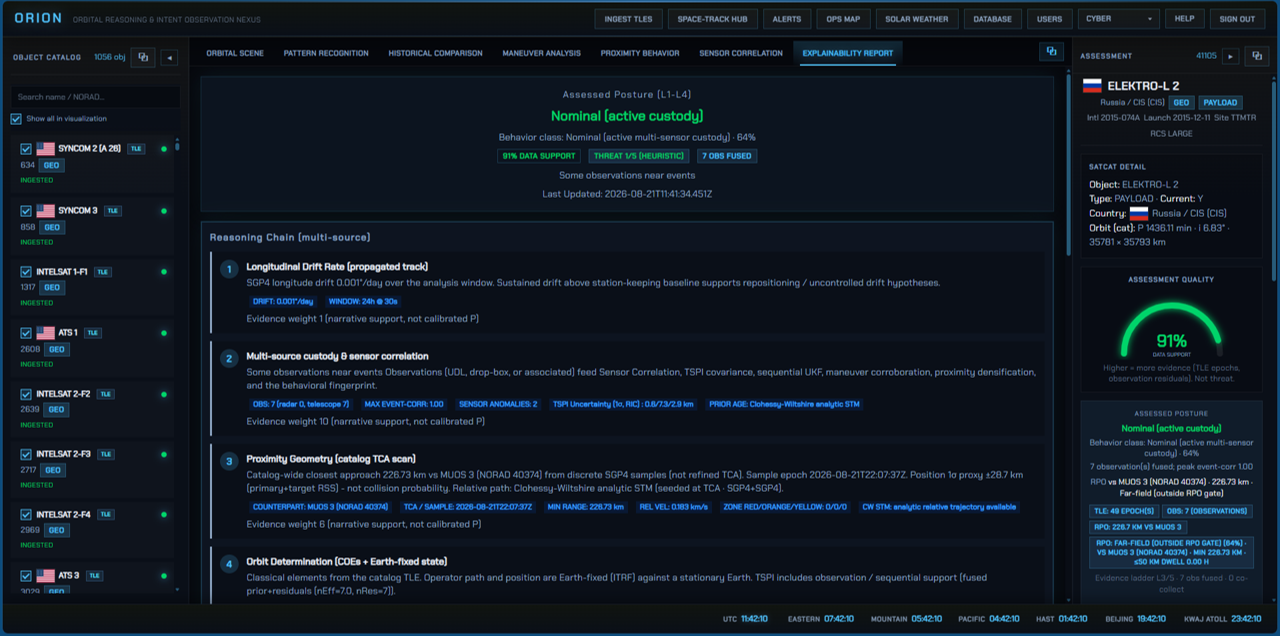
ORION introduces contextual markers that allow analysts to encode reasoning directly into telemetry streams. These markers become inputs to the intent engine.
Multi-Source Fusion Pipeline
Cross-domain orbital intelligence.
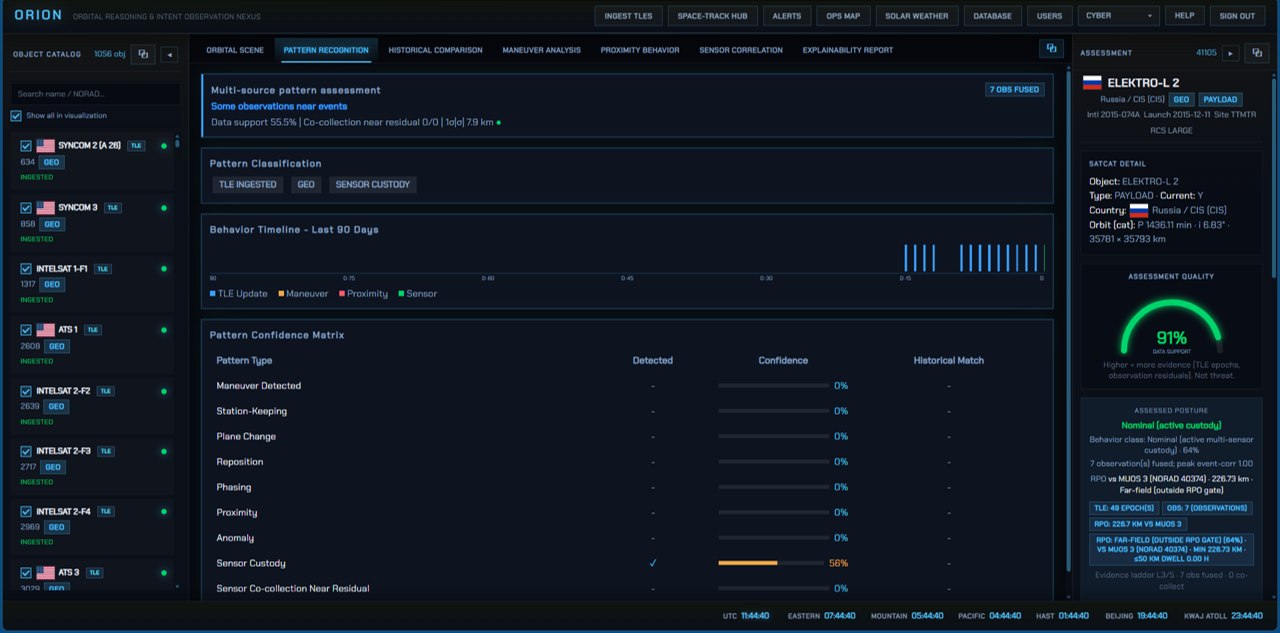
ORION processes telemetry, sensor logs, historical analogs, and mission-class priors through a unified intent taxonomy.
LEO / SSO Telemetry
High-cadence orbital tracks and maneuver detection.
GEO Belt Monitoring
Drift signatures and co-location analysis.
Sensor Payload Logs
SAR, EO, SIGINT, RF activation timing.
Historical Analog Library
Known inspection and RPO campaigns.
Mission-Class Priors
Behavioral expectations by mission type.
ORION Nexus Dashboard
Single pane of orbital reasoning.
The dashboard provides real-time reasoning for analysts, operators, and SDA watch floors.
Maneuver Detection
Live Δv events and classification.
Intent Likelihood
Dynamic visualization of intent vectors.
Proximity Risk
Threat envelopes and approach geometry.
Historical Similarity
Analog scoring against known campaigns.
Sensor Correlation
Payload timing vs. maneuvers.
Evidence Export
Versioned reasoning packages.
Structured Intent Evidence
Every run produces a complete package.
ORION generates intent vectors, confidence matrices, evidence chains, and contradiction analysis - all timestamped and exportable.
Mission-class likelihood distribution.
Propagation across evidence sources.
Traceable reasoning paths.
Handling conflicting signals.
Experiment Status
ORION is an active Helios Prime experiment - stable enough for mission use, flexible enough for continuous reasoning research.
Pre-Operational
Reasoning · Fusion · Intent
Multi-satellite intent graph inference