Overview: Not a Calendar, an Operational Container
Kairos is built for operational planning at scale. The experiment: can an event behave like a mission-native container rather than a timestamp? Can scheduling, metadata, attachments, logs, and asset linkage coexist inside one unified workspace?
"Kairos isn’t a calendar, it’s an operational container."
Unified Event Record Experiment
Kairos treats each event as a first-class operational object, a container with the metadata teams need to coordinate work and maintain traceability.
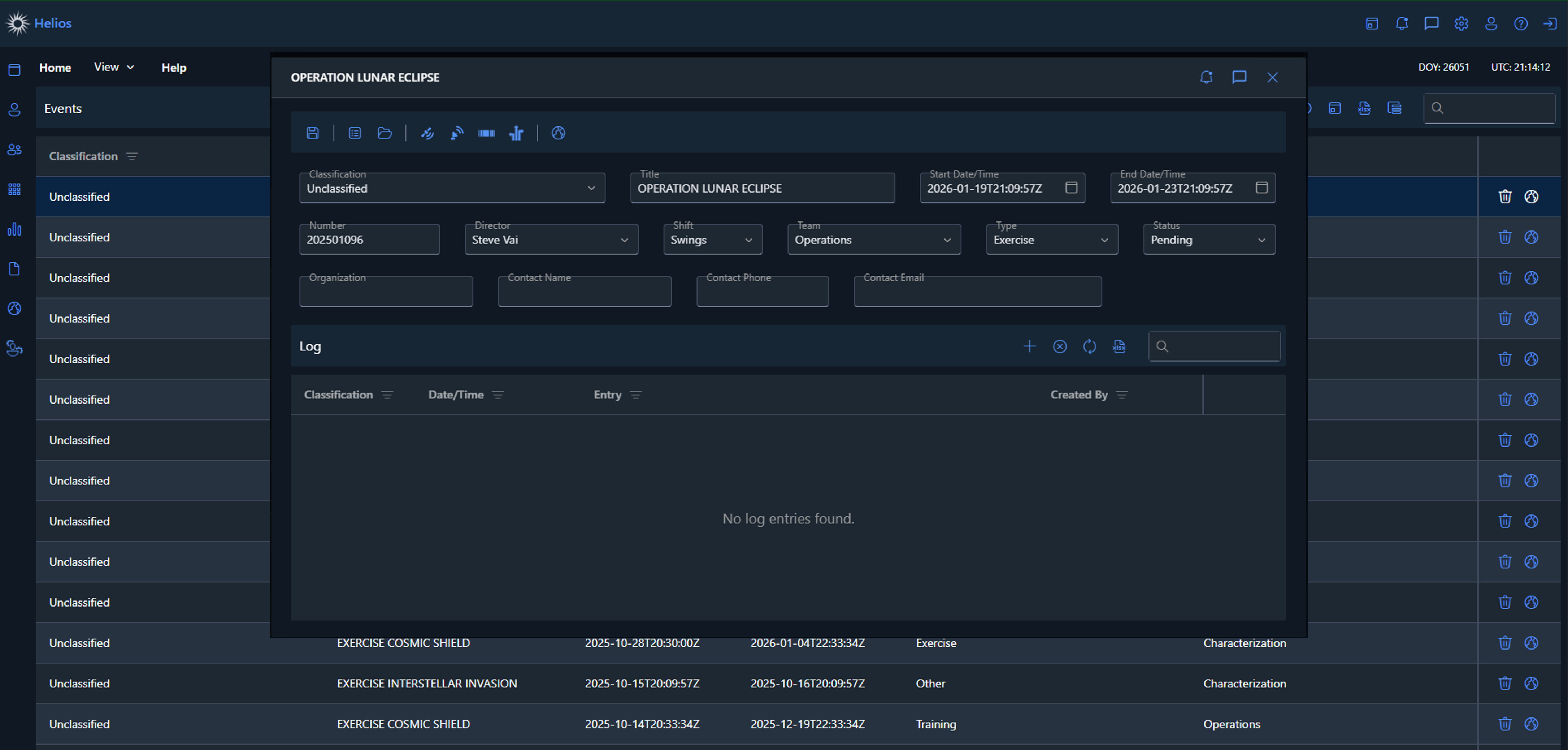
The experiment: can an event record become a coordination package, not just a calendar event?
Two Ways to Plan: Grid View & Scheduler
Kairos tested two planning modes to see how operators prefer to coordinate missions:
Grid View (List Mode)
Scheduler-First Planning
Event Form & Log
The event editor tested whether structured, validated fields and staged edits could reduce accidental loss, enforce classification discipline, and preserve operational traceability.
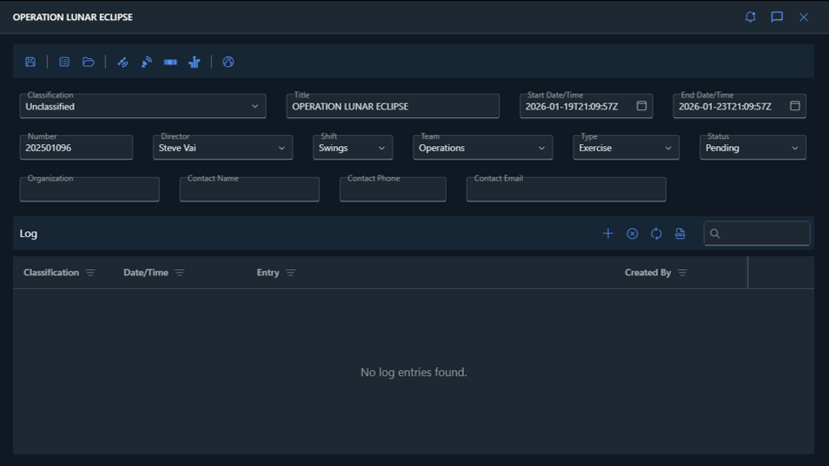
The experiment: can an event form behave like a mission coordination surface rather than a data entry screen?
Attachments: Binding Operational Context
Kairos tested whether briefs, imagery, reports, and screenshots could be bound directly to the event record, not scattered across shared drives.
The experiment: can attachments become part of the operational container instead of external artifacts?
Asset Linkage: Building the Operational Scope
Kairos tested whether events could link directly to mission-relevant assets, turning an event into a true operational package.
The experiment: can asset linkage transform an event into a mission-ready operational container?
Collaboration: Embedded Coordination Touchpoints
Kairos tested whether collaboration could live inside the event workspace, not in external chat tools or email threads.
The experiment: can collaboration become part of the operational container rather than an external workflow?
API-Driven by Design
Kairos exposed authenticated endpoints for event retrieval, CRUD operations, logs, and linked assets, testing whether operational containers could be automated and integrated across mission systems.
The experiment: can operational containers be automated without losing human context?
What Kairos Revealed
01. Events can be containers.
Operators treated events as operational packages, not timestamps, when metadata, logs, and attachments lived inside the record.
02. Planning modes must scale.
Grid view excelled at volume; scheduler view excelled at temporal reasoning. Both were necessary.
03. Logs are operational truth.
Timestamped logs became the backbone of traceability, more valuable than the event metadata itself.
04. Asset linkage changes behavior.
When events linked to orbital, ground, spectrum, and data assets, operators treated events as mission packages.
05. Collaboration must be embedded.
Operators coordinated more effectively when chat and notifications lived inside the event workspace.
Failure Logs
"Early forms required too much metadata. Operators skipped fields. Lesson: metadata must be structured, but never burdensome."
"Attachments were scattered across drives. Operators lost context. Lesson: attachments must be bound to the event record."
"Linking too many assets made events noisy. Lesson: linkage must be curated, relevance over volume."
Open Questions
Kairos answered many questions about operational containers, and opened a few new ones:
"How much metadata is optimal for mission coordination?"
// Most events have a common baseline (start date, duration, orgs, etc). Thought is Kairos can be ""configured" to support specific event types/domains. Active area of development.
"What new asset types should events link to?"
// Similiar to metadata, flexible configuration is key. Active area of development.
"How should collaboration evolve inside the event workspace?"
// Partially addressed, not yet well-characterized.
"What automation should the API layer enable next?"
// Emerging priority.
"How can event containers scale across multi-mission environments?"
// This too is a configuration problem.