Residual-Driven Evidence for SDA
Selene is built around a single analytical premise: residuals, the difference between what a sensor observes and what a model predicts. Residuals contain more information than they are typically given credit for. Bias, drift, discontinuities, and non-random structure in residuals are not just noise to be filtered. They are evidence of maneuvers, anomalies, sensor degradation, and model failures.
Selene transforms that evidence into transparent, repeatable, explainable indicators that analysts can examine, compare, and act on, without requiring access to classified ground truth.
"Residual analysis is the foundation. Every capability in Selene (maneuver detection, sensor trust scoring, orbit health assessment, etc.) is grounded in what residuals reveal, not in what models assert."
Residual Intelligence Suite (RIS)
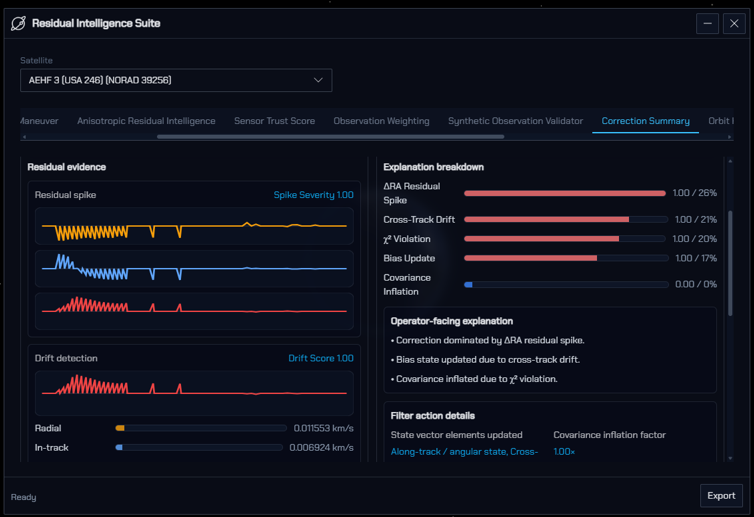
Selene is anchored by the Residual Intelligence Suite (RIS), a collection of prototype experiments that transform raw residuals into interpretable, actionable evidence.
Maneuver Characterization & Residual-Based Detection
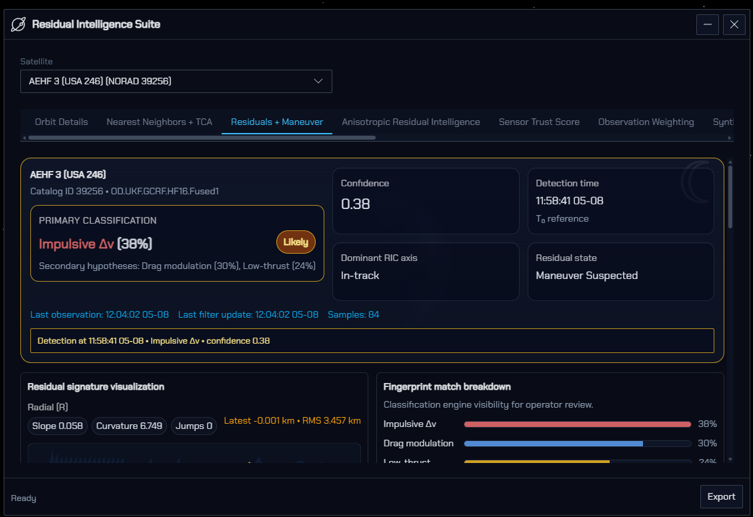
Identifies maneuver signatures in R/I/C coordinates using TLE differencing, drift removal, robust normalization, and residual cues such as discontinuities, χ² spikes, and spectral structure.
Maneuver Fingerprinting via Residual Shape Library
A physics-grounded library of RIC residual shapes enables probabilistic, explainable classification of impulsive Δv events, low-thrust behaviors, drag/SRP effects, plane changes, and station-keeping patterns.
Residual-Space Clustering & Non-Parametric Anomaly Detection
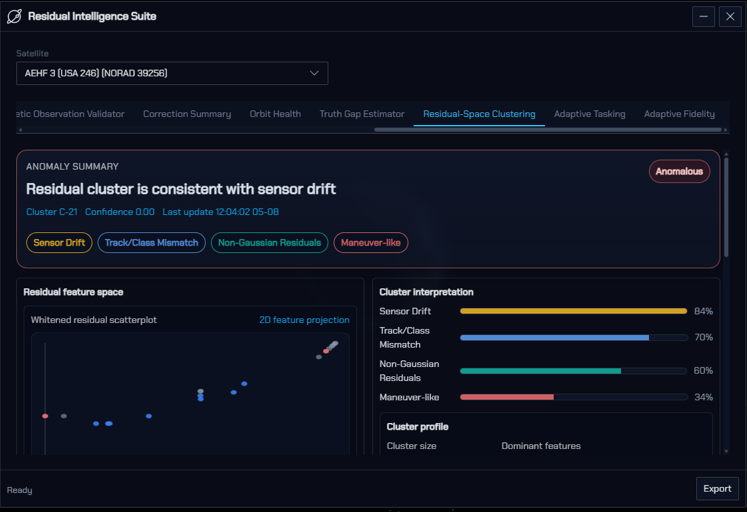
Unsupervised clustering in whitened residual space separates maneuvering behavior, sensor drift, track inconsistency, and non-Gaussian anomalies creating an independent detection channel.
Synthetic Observation Validator & Truth Gap Index
Compares synthetic and real residual distributions to quantify realism, tune sensor models, and compute a Truth Gap Index summarizing distance to truth bounds.
Adaptive Tasking
Residual-driven tasking prioritization (e.g., directing sensor attention based on what residuals reveal about track quality, maneuver likelihood, and estimator consistency).
Adaptive Fidelity Engine (AFE)
The Right Model for the Right Moment
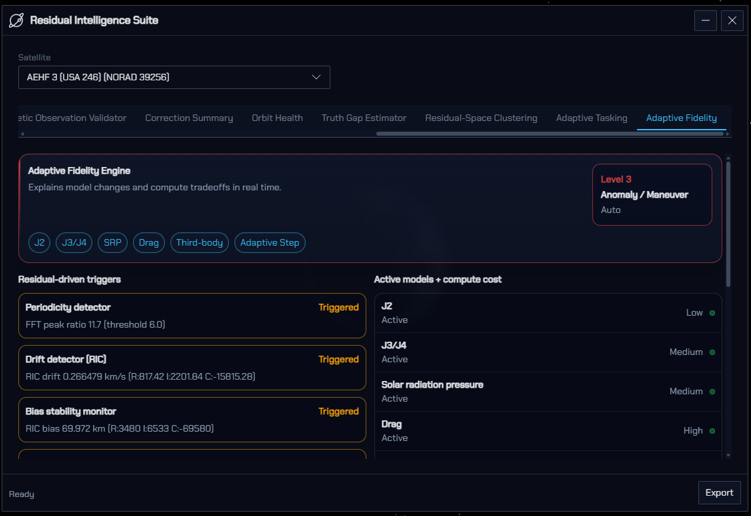
The Adaptive Fidelity Engine performs residual-driven model selection activating appropriate force-model fidelity based on bias, whiteness, and spectral structure in the residual stream.
"The model should fit the evidence. Selene does not apply maximum fidelity by default, it applies the fidelity the residuals justify. This keeps the estimator honest and the computational cost proportional to the problem."
Sensor Trust Score & Residual-Informed Observation Weighting
Not All Observations Are Equal
Real-time trust scoring and adaptive weighting improve fusion stability, estimator consistency, and cross-sensor coherence. Selene treats sensor trust as a dynamic, residual-informed quantity, not a static configuration parameter.
"A sensor's trust score is itself an evidence artifact. Degradation in trust, sudden or gradual, is an indicator of sensor health, environmental conditions, or object behavior that Selene surfaces as part of the observable picture."
Orbit Health Score & Explainability Layer
One Number. Full Transparency.
The Orbit Health Score combines RMS, χ², bias stability, sensor trust, and maneuver likelihood into a single, concise metric with a full explainability layer that shows exactly how each component contributed.
"Every Orbit Health Score is accompanied by a full decomposition: which component drove the score, why, and what the residual evidence looks like. Analysts are never asked to trust a number without understanding it."
SeleneAI
A Natural-Language Interface for SDA Analysis
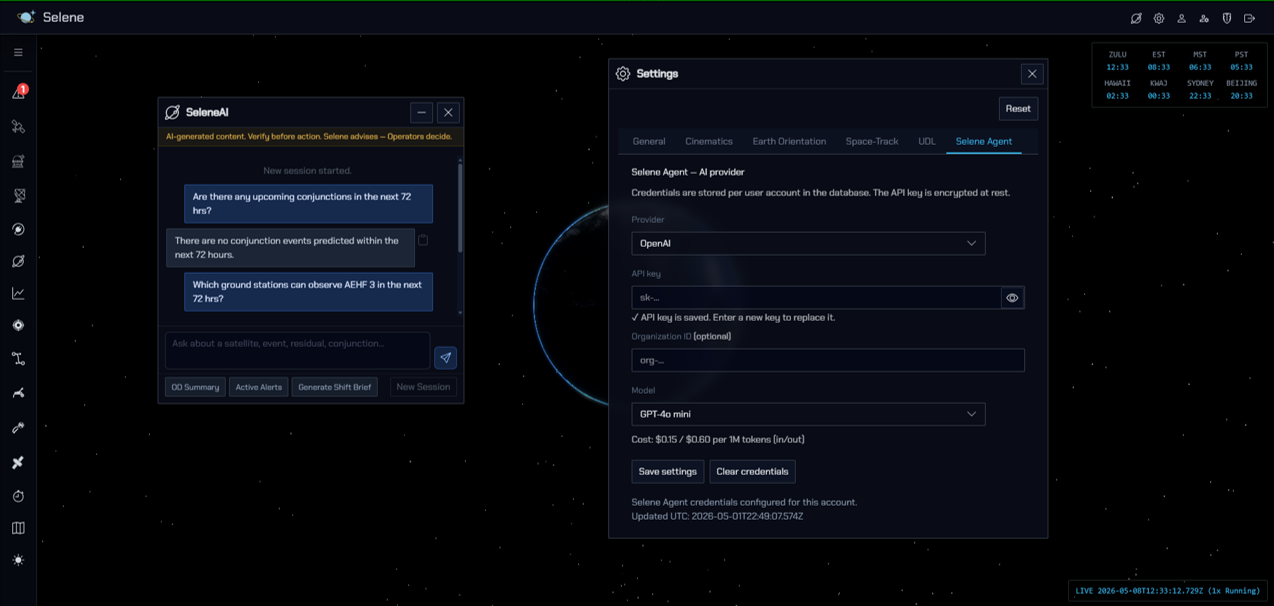
SeleneAI is an experimental AI assistant integrated directly into the Selene environment. It is capable of executing and evaluating Selene orbital, fusion, and threat-analysis workflows through natural-language interaction.
SeleneAI operates as an embedded agent within the Selene 3-D analytics environment. Analysts can direct orbital analysis, request residual comparisons, initiate maneuver characterization workflows, and evaluate estimator behavior through natural-language queries, without navigating the full interface manually.
This is an experimental capability. SeleneAI is a prototype within a prototype.
What We're Still Working Out
These are honest open questions, not answered by the current implementation.
"Can residual geometry predict maneuvers before they occur? Are there reliable precursors in residual space?"
"Can residual-space clustering be used to identify adversarial behavior?"
"Can residuals quantify sensor degradation early enough to trigger proactive re-tasking?"
"Can synthetic residuals be used to design better sensors, not just better models?"
"Can SeleneAI learn to reason scientifically about residuals rather than just describe them?"
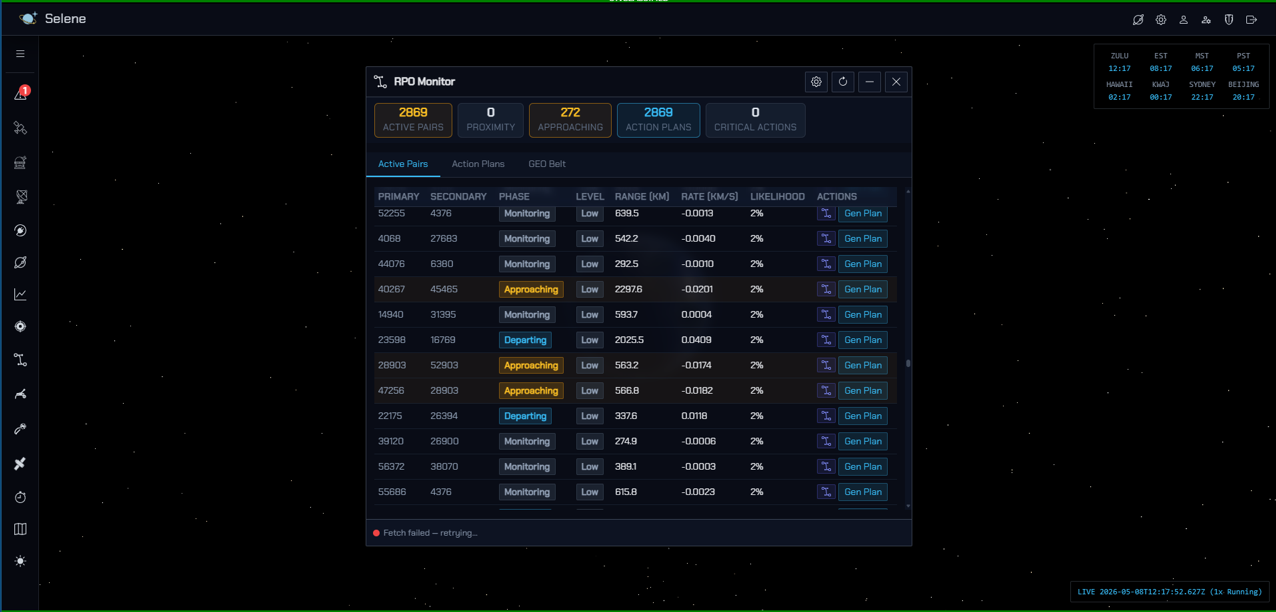
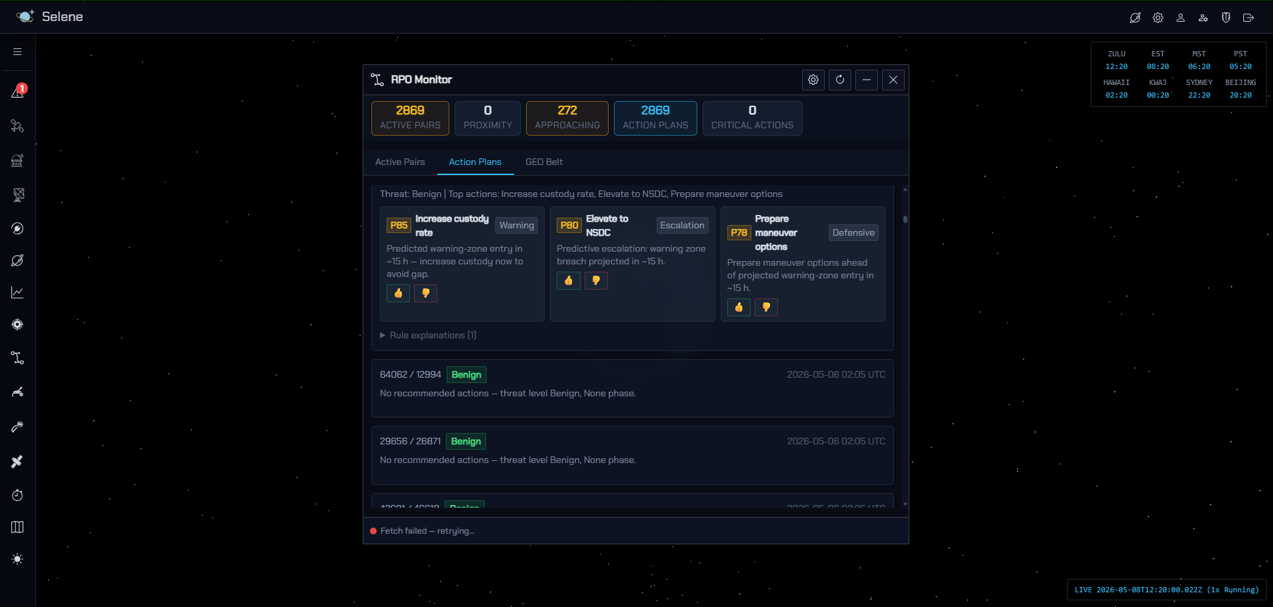
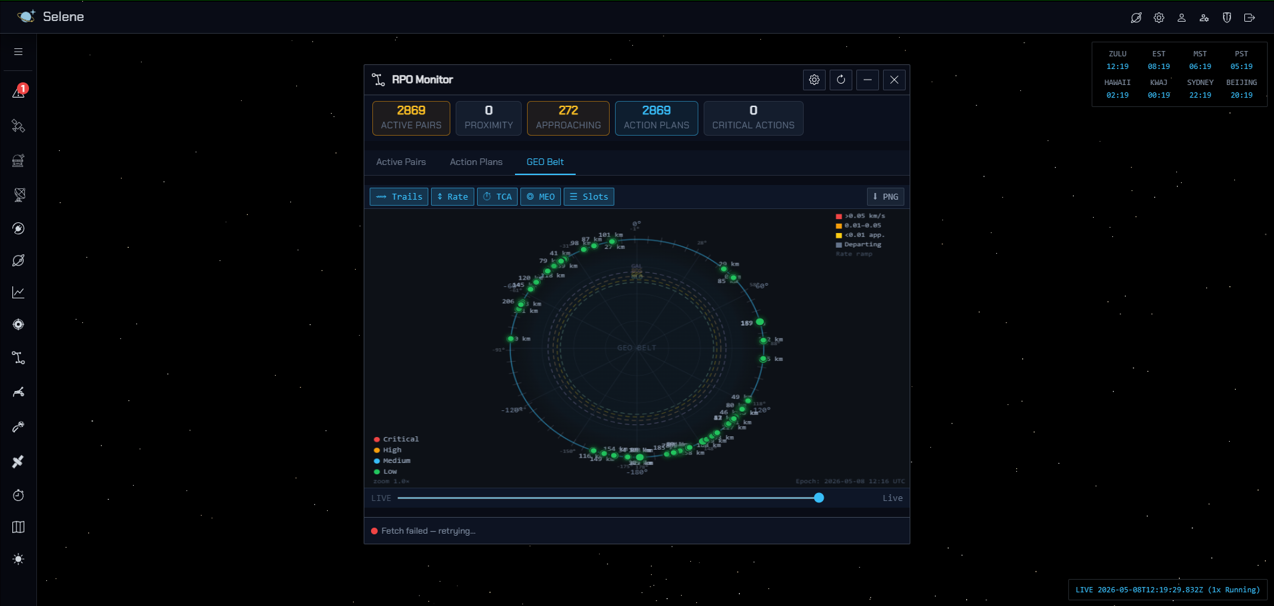
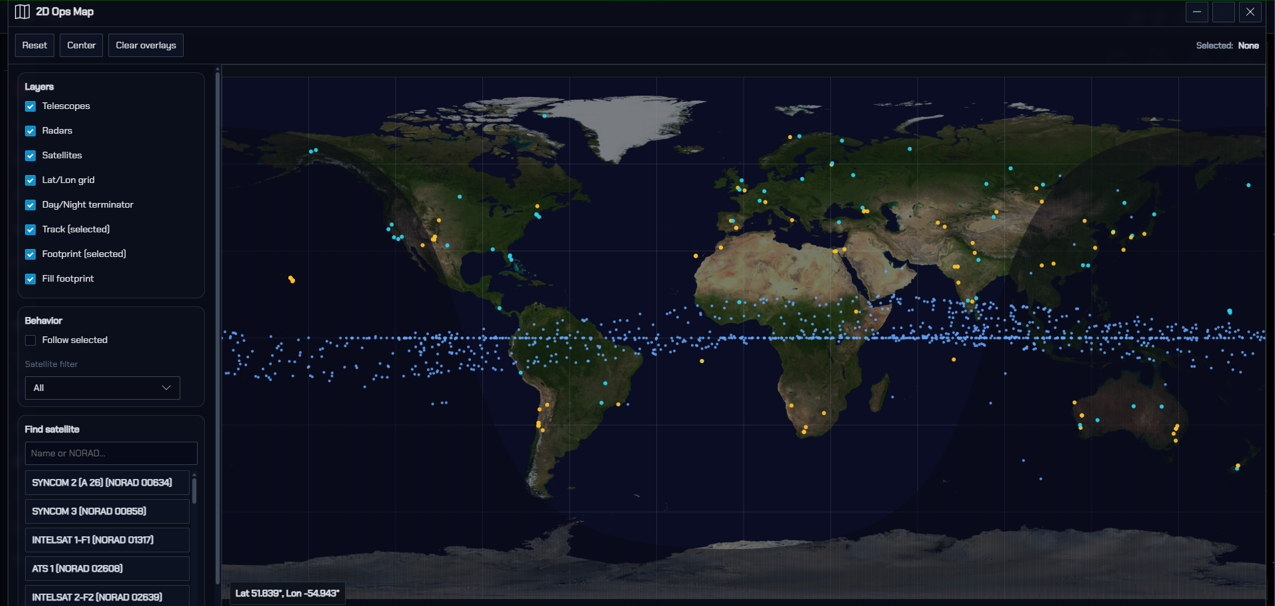
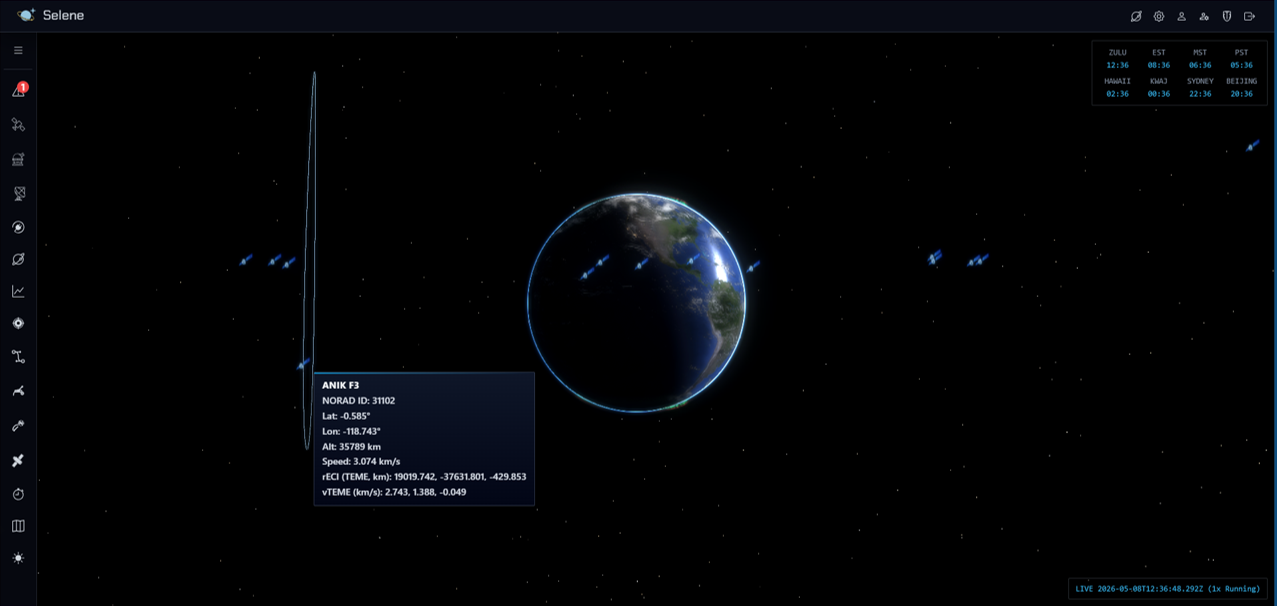
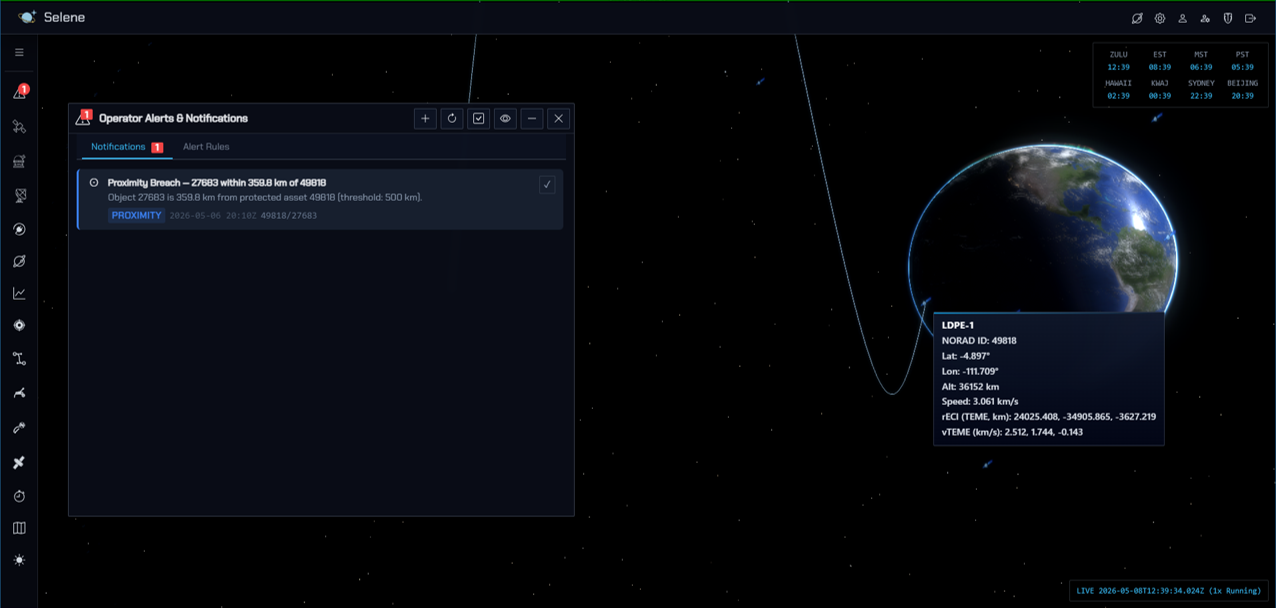
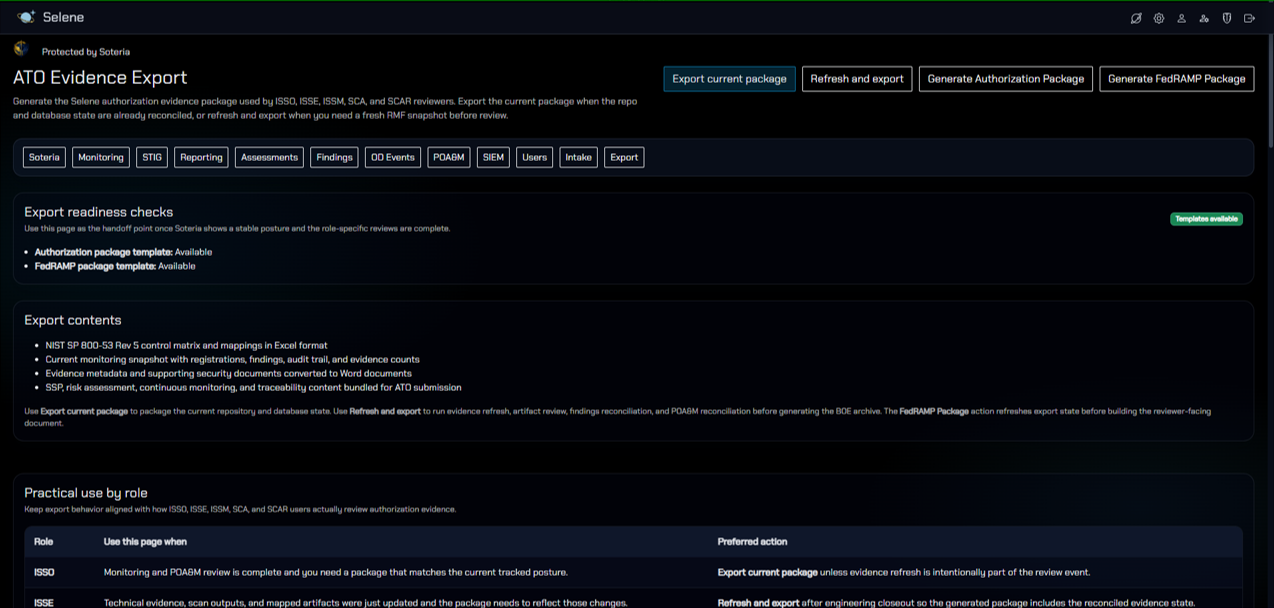
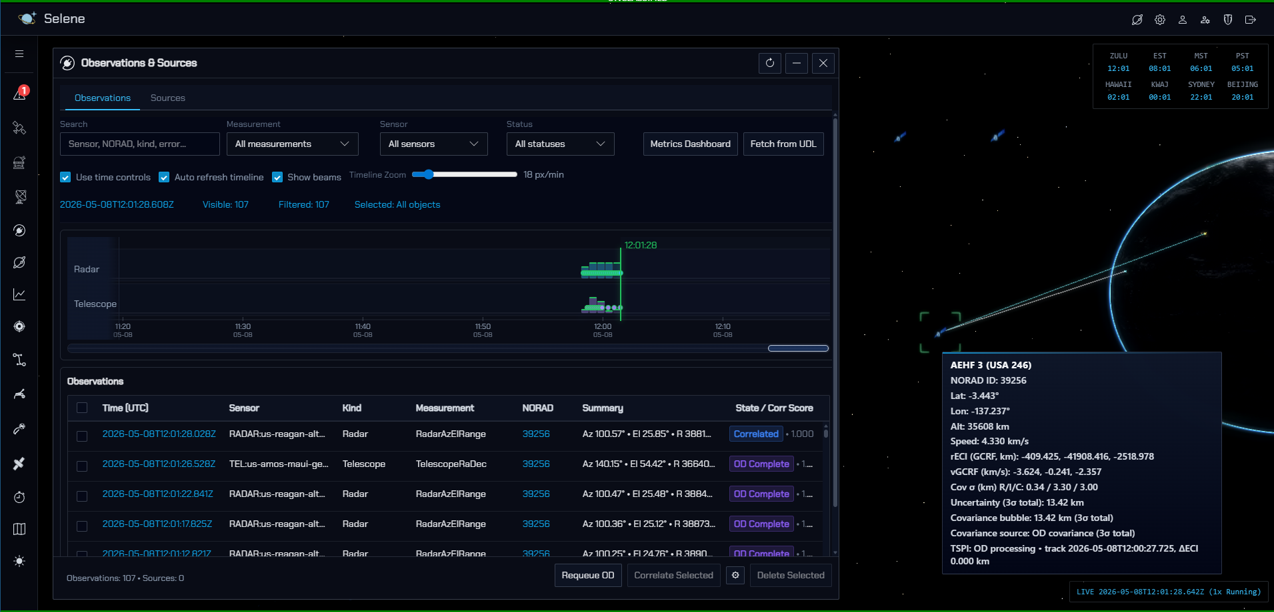
Screenshots
Selene experiments to good to leave out, just no time to describe. We'll get to it.